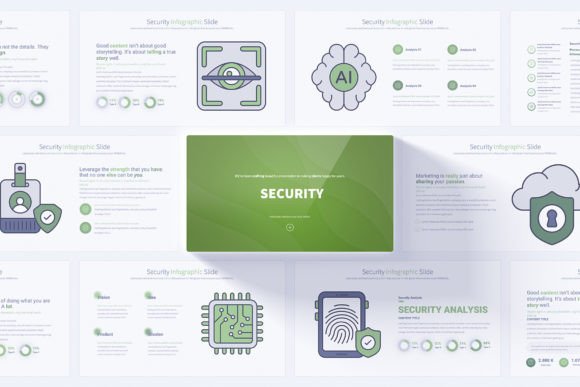
Security PowerPoint Infographics: The Power of Visual Communication in a Digital World
Presenting complex security concepts is a critical task in today's digital landscape. Whether you are a cybersecurity analyst explaining a new threat vector, a business leader outlining a data protection strategy, or a consultant proposing risk mitigation frameworks, the clarity and impact of your communication can directly influence understanding and action. In this environment, Security PowerPoint Infographics emerge not as mere decorative templates, but as essential tools for effective visual storytelling.
The Growing Necessity for Visual Security Communication
The field of security, encompassing cybersecurity, physical protection, and business risk management, has evolved from a niche technical concern to a central business function. This shift has broadened the audience for security presentations. You are no longer speaking solely to IT departments; you must engage executives, board members, regulatory bodies, and even the general public. These diverse audiences often lack deep technical expertise but need to grasp high-stakes concepts quickly and accurately.
Traditional slides filled with dense text and bullet points fail to meet this need. They overwhelm rather than illuminate. Modern user expectations demand presentations that are polished, professional, and, above all, clear. This is where a dedicated Security PowerPoint Infographics template becomes invaluable. By transforming abstract protocols, statistical data, and layered strategies into intuitive visual formats—charts, diagrams, process flows, and icon-driven layouts—you bridge the gap between complex information and audience comprehension.
What Makes a Specialized Security Infographic Template Essential
A generic presentation template can be a starting point, but it often lacks the thematic coherence and specific visual language required for security topics. A purpose-built Security PowerPoint Infographics slides collection is designed with this context in mind. Its value lies in several key areas:
First, it provides immediate relevance. Slides pre-designed with security-centric layouts—such as threat landscape maps, data encryption diagrams, incident response timelines, or risk assessment matrices—allow presenters to slot their content into a framework that visually signals the topic. This saves hours of trying to build these complex visual structures from scratch.
Second, it ensures visual consistency and professionalism. With 17 unique slide designs offering 204 total slides through variations, and crafted in 16:9 Full HD resolution, every part of your presentation maintains a polished, cohesive look. The inclusion of 12 color variations on a light background allows adaptation to different corporate branding or presentation tones without sacrificing readability and a professional aesthetic.
Adapting to Modern Workflows and Creator Needs
The modern professional’s workflow is often fast-paced and iterative. Presentations need to be updated frequently, adapted for different stakeholders, and customized with specific data. A template that is merely a static set of images becomes a bottleneck. Therefore, the practical implications of a template’s design are crucial.
Features like easy customization via Slide Master and fully editable elements address this directly. Changing a global color scheme or font across 204 slides can be done in minutes, not hours. The bonus of 280 fully editable vector icons and handmade security infographics means you can tailor every detail. If a specific icon doesn’t match your exact need, you can modify its shape or color because it’s a vector, not a fixed image. This level of control is what separates a flexible tool from a rigid product.
Furthermore, the inclusion of animated transitions is not about frivolous effects. In security presentations, animation can be used purposefully to reveal a process step-by-step or to show the flow of data through a secure system, making the narrative dynamic and easier to follow.
Practical Applications Across Professional Fields
The utility of these infographics extends across numerous roles and scenarios. For the cybersecurity professional, it might be used to present a forensic analysis of a breach, using timeline infographics to detail the attack sequence. For the business protection consultant, slides designed for comparative analysis could illustrate the effectiveness of different security investments. An educator or trainer could use the simplified iconography and diagrams to teach fundamental security principles to new staff.
Consider a realistic example: A Chief Information Security Officer needs to present the annual security posture report to the board. The report contains data on incident counts, budget allocation, threat rankings, and future strategy. Using a Security PowerPoint Infographics template, the CISO can replace pages of spreadsheets with a clear dashboard slide, a beautifully formatted budget distribution pie chart, a hierarchical threat pyramid, and a strategic roadmap infographic. The board members, whose time is limited and expertise varied, can absorb the key messages visually, leading to more informed questions and decisions.
The Role of SEO and Accessible Documentation
From a usability standpoint, features like the PowerPoint PPTX format ensure compatibility with the software most businesses use daily. The included PDF documentation provides a quick-start guide, reducing the learning curve and making the template truly user-friendly. This attention to the complete user experience—from download to final presentation—reflects an understanding of the practical needs of creators, who are often working under time constraints.
Why Visual Tools Are Getting More Attention
The increased attention on tools like specialized infographic templates is part of a broader trend toward visual communication and design thinking in business. As data becomes more abundant and operations more complex, the ability to distill and visualize is a competitive skill. Security, being a high-pressure and high-consequence domain, is a prime candidate for this approach. People are paying more attention because the outcomes—better understanding, faster decisions, and more effective resource allocation—are tangible.
Moreover, the expectation for quality has risen. A poorly designed, text-heavy security presentation can inadvertently undermine its message, suggesting a lack of modernity or care. A professionally designed, visually compelling presentation reinforces the seriousness and sophistication of the security program itself.
Implementing Security Infographics: Recommendations and Best Practices
To leverage a Security PowerPoint Infographics template effectively, start by mapping your content to the available slides. Don’t force content into a visual that doesn’t fit; use the 17 unique designs as a menu of options. Customize deliberately: use the color variations to align with your company’s palette, and edit the vector icons to match your specific terminology (e.g., changing a generic “lock” icon to a more specific “biometric authentication” symbol if needed).
Remember that the infographics are a support to your narrative, not a replacement. The clarity they provide should be paired with concise, well-scripted verbal explanations. Use the professional opening and closing slides to frame your presentation with a strong, secure identity from start to finish.
Ultimately, investing in a dedicated visual tool like this is about investing in communication efficacy. For professionals, creators, and businesses operating in the vital realm of security, it represents a practical step towards ensuring that your critical messages are not just delivered, but understood, remembered, and acted upon.